Showing posts with label magick. Show all posts

25 January 2021

Magick vs. Magical Thinking

 There are many things that separate effective magickal practitioners from mediocre ones, but it’s not necessarily the things that immediately come to mind.  It’s not about having the shiniest crystals, an abundance of rare herbs, or the stamina to stay up into the wee hours of the night to do a spell at the *exact* auspicious moment.  It’s about understanding.  One of the most important, yet overlooked, aspects of what makes a great practitioner is a full understanding of the difference between magick and magical thinking.  

Magick, as defined by Aleister Crowley, is "the Science and Art of causing Change to occur in conformity with Will."  More concretely, performing magick is when a practitioner has an intention that they deliberately charge with focussed energy and then direct to a target in the world to manifest that intention.  For example, a simple act of magick would be to hold a small candle while focusing on improving luck for oneself, allowing that focussed energy to flow into the candle, and then lighting the candle so that it releases that energy into the world to manifest better luck.  Real magick is the work of raising energy, tuning it to an intention, and then directing it to a target to create change.  

Magical thinking is believing that one event happens as a result of another without a reasonable link of causation.  They key words there are: “reasonable link of causation.”  When someone plants a seed and then a plant grows from that seed, there is an obvious link of causation between the act of planting and the subsequent plant growth.  Whe, someone plants a seed and suddenly a car backfires down the road, there is no reasonable link of causation between the planting and the car backfiring.  If someone were to believe that the act of planting a seed could make a car backfire, that would be magical thinking, as the two occurrences have nothing to do with one another.  A classic example of magical thinking is a sports fan believing that their team cannot win unless that fan wears their lucky socks.  Of the myriad factors that influence the outcome of a sports match, what one fan sitting at home has on their feet cannot “reasonably” be counted among them.  

On the surface it’s easy to blur the lines between magick and magical thinking.  They both involve something far removed from a situation being attributed with influencing the outcome of  that situation.  The distinction lies in what constitutes a “reasonable link of causation.”  Let’s return to our sports fan.  In the magickal thinking example, the sports fan simply puts on their lucky socks and watches the game.  There is no effort to set an intention, raise energy in any way, or to direct it (beyond shouting at the television).  Absolutely nothing about that behaviour can reasonably be seen as having a causal link to the outcome of the game.  However, if that sports fan were to deliberately set an intention for their team to play their very best and have good luck, raise energy to charge those lucky socks with that intention, and then wear them and use watching the game as a mechanism to send that intention to the team; that would be magick.  Magick requires effort to create a causal link, magical thinking does not.  Magick is a way of working towards achieving a goal, magical thinking is wanting something and just expecting the universe to give it to you.

To further muddy the waters, it is possible to employ magical thinking while actually practicing magick.  This is most often seen in the grandiosity of what a practitioner aims for in their workings.  Expecting to manifest a laptop out of thin air with a mere incantation is magical thinking.  Yes, the practice of magick takes the view that nothing is impossible, but that doesn’t mean that magick is limitless.  Real magick is about nudging probabilities; making the possible more likely.  An effective working to find a new job might involve something to help you find the best jobs to apply to or making your resume more attractive to recruiters; simply lighting a candle while taking no mundane actions to find a job is unlikely to manifest the result you desire.  Magical thinking is believing that magick will do all the work for you while you sit back and have a latte.  Magick is work and it requires a lot from the practitioner to be truly effective.  It goes back to the “reasonable link of causation” idea.  Subtle energetic manipulations (a.k.a. magick) can reasonably make subtle energetic shifts, such as nudging something from a 85% probability to an 87% probability.  Such acts cannot reasonably nudge probabilities to change from 10% to 100%.  Sure, there are long term spells that can achieve monumental results, but they’re doing so one tiny achievable step at a time.  If you want to change your life, magick can help you determine which actions to take, strengthen your will to enact the changes, even weaken obstacles in your path, but it cannot make all the changes for you - you will not do a spell and simply wake up a different person the next day.  

Magick is a wondrous and empowering tool to help you achieve your goals.  However, just as buying fancy knives and a toque won’t instantly make you an expert chef, simply reading a few words from a book while wanting something won’t make it yours.  True magick requires deliberate and palpable effort and can only deliver something reasonably attainable. View your magicks as a support to your mundane actions, rather than substitutes for them.  Think rationally about what you want, do what mundane actions you can to bring your desires to fruition, and then do magick to push your efforts over the line.  Do this and you will avoid the trap of magical thinking and only do true magick.


24 March 2020

Stay Home; Do Magick


Things in the world are...not great right now.  Here in Seattle we've just received a stay-home order and closure of non-essential businesses.  My husband and I have been working from home for going on three weeks.  The anxiety and disruption of peoples lives is the highest it's been in my lifetime.  As a witch, the best thing I can do right now is stay home and do magick.

I hope the whole "staying at home" thing requires no explanation.  If you don't understand that, then you should probably put down the candle and just go watch some YouTube.  If you're still reading this, congratulations you're not a dumb ass!   Now let's get to work.

The world needs magick more than ever and we can be part of the solution.  That doesn't mean we all need to start attempting to heal the world.  I, for one, am a shitty healer.  I can destroy things, purify, and create barriers like a champ; but whenever I attempt more than the most minor healing I end up doing more harm than good.  Thankfully, there are TONS of things we can do magickally to help ourselves and our communities in dealing with the trash fire that is 2020.

Each practitioner has their own strengths; what we need to do now is figure out how each of our individual strengths can help and then actually do so.  Here are some common magickal strengths and suggested ways of applying them:
  • Protection: Create strong energetic barriers around yourself and loved ones (with permission) to help enforce social distancing and create a sense of safety.
  • Cleansing and Purification: Add magickal fuel to your mundane cleaning and sanitation practices to boost their effectiveness (this is just a boost, not a replacement for soap!).  Do workings to cleanse negative energy from your home and the public spaces in your neighborhood.
  • Hearth Magick: Create an energetic oasis in these anxiety riddled times.  Add love and healing energies while cooking to make your food nourish body and spirit.
  • Prosperity: In this time of economic uncertainty, do workings to enhance prosperity and stability for your family and community.  If you're fortunate enough to have financial stability and the ability to make charitable donations, infuse your gift with energy to encourage others to donate as well.
  • Luck: Honestly, we all need as much good luck as we can get right now.  Do all you can.
  • Spirit Workings: We need all the allies we can get right now, so encourage your spirit allies to help you and those around you to stay healthy and stable, as well as helping to heal the sick.  If you work with the ancestors, this is the time to ask them to help protection our vulnerable elders and those with fragile health.
  • Justice/Activist Magick:  Work on our law and policy makers to force them to put the good of the people before their pocketbooks.
  • Healing: The world is an energetic open wound right now and we need all the healing we can get.  As for physical healing, unless you're an expert and feel confident working otherwise, keep your focus small and to those who explicitly reach out to you.  As always, magickal healing is a support to mundane medicine, never a replacement.
These are just a few suggestions of the many ways we can all use our strengths to help out in these troubled times.  I encourage you to get creative and use the magick you already do well to make your little corner of the world a little bit better.  Focus on the small steps you can take every day and you will be surprised at the difference you can make.

Don't forget to take time for self-care as well.  Exhausting ourselves helps no one.  We can't be positive all the time.  Allow yourself time to freak out a little (or a lot) and be gentle with yourself.  Do what you can and don't stress what you can't. 

For my part, I'm doing a lot of work with Santa Muerte to protect the vulnerable.  If you're interested, I'll be doing a public Santa Muerte Rosary online via Zoom on 4/5/2020 at 1pm pacific time (Santa Muerte Rosary Details).

Take care of yourself and stay safe out there!

24 March 2017

So You Want to be a Death Witch

Over the last few months the number one question people have been asking me is: how do I get started working with Death and the dead?  How do I become a death witch?  In the preceding decade not one person ever asked me that question.  Given the general state of the world it’s not exactly surprising that more and more people are being drawn to the darker side of witchcraft.  However, death work is not something to be entered into casually.  Here are a few things you need to know before starting down the path of a death witch.


What does it mean to be a death witch?

As with any occult identity, if you ask a dozen different death witches what it means to be one, you will get a dozen different answers.  In short, it is a witch who works primarily with the forces of death and/or the dead.  What that looks like can take many forms and depends greatly on the traditions and culture of the individual.  Most magickal traditions have some branch dealing with death and the dead, but someone who occasionally contacts an ancestor or officiates a funeral is not a death witch. 

To be a death witch there must be a resonance in your soul with the forces of death and the dead that compels you to work with them.  For me that manifests as an intense sense of belonging and kinship with the forces of death and comfort with being around the dead.  When I am in the presence of the forces of death it feels like being surrounded by family in the best of ways.  I find cemeteries and haunted places to be incredibly welcoming and try to spend time in them as often as possible - paying all due respects to those reside there.  Very early in my explorations of Paganism and Polytheism it became clear that my focus was to be with Death.  That may not be the case for you.  There are many ways the pull towards death work can manifest; if you feel it, then you should pursue it.

How do I get started?

The most important thing about working with Death and the dead is respect.  Every chthonic deity is different; every spirit is different.  Some death deities are very casual, some are very strict - know the stories and basic personality of the deity before you approach them.  An offering for Hades is very different than an offering to Santa Muerte, as are the behaviors they expect from those approaching them.  The same holds true for the dead.  The dead are just people who have passed on to the other side of the veil and they all have particular wants, needs, and personalities.  Treat them with the respect you would have treated them with in life.  A little time and effort goes a very long way towards forging positive relationships with the forces of death and the dead.

The easiest place to start in death work is your own ancestors, be they of blood or spirit.  Ancestors of blood are your actual deceased relatives.  Ancestors of spirit are those that paved the way for your spiritual being, including teachers, artists, writers, etc., whose words and works helped shape the person you are today.  Begin by creating an ancestor altar.  If you have the space this can be a shelf or the top of a dresser where you place pictures or representations of your ancestors.  Keep this space clean and add things like fresh flowers, a glass of water, or incense offerings as a sign of respect.  If you don’t have the space for a physical altar you can create a photo album or digital representation of what you’d like on an altar.  The purpose of an ancestor altar is to be a focal point for your work and to be a place for the energies of your ancestors to reside.  What that looks like is far less important than the simple fact that you’ve taken the time and trouble to build it.  Your investment of energy and attention to your ancestors will begin building a relationship with them.  Creating a relationship with the dead means that when you need advice or a helping hand on the spiritual plane you will have willing aides when you need them.

***Note - not all of everyone’s ancestors of blood are necessarily folks you want to invite into your life.  You get to choose who goes on your altar and you are allowed to say no if someone uninvited shows up.***

Once you’ve begun cultivating a relationship with your dead you can look into working with death deities or anthropomorphic forces of death.  Of course you can do this work before or instead of working with your ancestors, I just find it easier in this order.  Begin by reading myths regarding death and see what stories resonate with you and why.  If you’re lucky you might find other practitioners that work with that deity to compare notes with, but your own feelings and impressions are your best guide for your relationship with any deity.  Sometimes these deities will reach out to you rather than the other way around, it will be fairly obvious if it’s happening.  Once you’ve found a deity that resonates with you then you approach them just as you would any other deity.  That may mean building an altar to that deity, making offerings, doing magickal works, simple devotions, or something else entirely.  I’ve not found working with death deities any more onerous or risky than working with any other deity.  In fact, many death deities are a lot more relaxed than their above ground cousins, but it all depends on the particular deity. 

Once you’ve begin building relationships with the dead and the forces of death you can begin the deeper spiritual and magickal works of a death witch.  That’s a whole series of posts in and of themselves so I won’t go further just yet. 

If you think you want to be a death witch start by talking to the dead: get to know them, build relationships with them.  Then get to know the different death deities and see if any of them call to you.  Explore with respect and you shouldn’t have any problems. 

If people are interested, I will be on a necromancy panel on 4/2/2017 in Seattle:
Life Among The Dead:A Panel On Necromancy
Sunday, April 2 at 5 PM - 6 PM
Spooked In Seattle Ghost Tours
102 Cherry St, Seattle, Washington 98104
https://www.facebook.com/events/155695498274683/

31 January 2017

How to Hex

Lately I’ve had several people come to me expressing a desire to curse...particular people.  Traditionally, curses come into favor when people feel that more direct/public/legal means of seeking justice fail them and they feel disempowered.  It is no surprise that they are coming back into fashion in times like these.  I’ll teach you a few methods for slinging a hex, but what you do with them is up to you.

What

Hexing/cursing is the final recourse for the marginalized, disenfranchised, and dispossessed.  It is what you do when the last straw has finally broken the camel’s back, or at least it should be.  Before casting a curse you should, if you are safe to do so, follow every legitimate path for finding a solution to your problem.  Attempting to curse someone/something before trying more traditional problem solving methods, when they’re available to you, rarely ends well for anyone.  Cursing is not what most people would call a “good” thing to do.  Cursing/hexing causes harm and there are consequences for sending harm out into the world.  You need to be prepared to deal with those consequences when they come - and they will come.  As Dorothy Morrison says, you need to be “wicked pissed” before casting a curse.  You have to mean it with every fiber of your being, consequences be damned.

Why

Once you’ve determined that you are “wicked pissed” and willing to accept the consequences, you need to determine just what you want to accomplish.  There are generally two reasons to cast a curse: 1) to stop bad things from happening/continuing, and 2) to punish someone for causing harm. 

I generally discourage people from cursing for the second reason because it rarely helps.  Most people do bad things when they’re in pain.  Hurting someone who is in pain does not tend to encourage them to behave better; it mostly makes things worse.  Further, miserable people rarely need help from me to destroy their lives; they do a fine job of it on their own.  Someone needs to have done something really bad (e.g. hurt a child, incited terrorism, massively subverted justice, etc.) for me to encourage hexing them for punitive reasons.  There are, of course, many ethical/moral reasons not to do this.  I leave you to make your own decisions there.

Cursing in order to stop “bad things” from happening is a much less morally ambiguous thing to do.  When things get bad enough and you really care about the situation then you need to get proactive.  In its best incarnation, a curse should be the magickal equivalent of punching a nazi in the face.  Of course, you must keep in mind what I said earlier - making miserable people more miserable rarely stops them from behaving badly.  Be very mindful of the potential consequences of your magick and only do things that will actually help the overall situation - not just feel cathartic.  For example, you might want to stop a serial rapist by making him impotent.  This might just make him angry and more prone to violence, thus making the situation worse rather than better.  A more effective curse might be one aiming to get the perpetrator caught and convicted.  If your goal is to stop a bad situation then you MUST calm your anger and really think things through in order to get the best results.  Take the long view of things.  Take the time to do some divination to determine the best course of action; consult your elders and ancestors; get advice from people you trust.  Make sure you feel that you truly need to do what you plan. 

How

There are nearly infinite ways to cast a curse.  Here are just a few ranging from “morally dubious” to “you’re going to do what?!”  You can google any of these types of spells and find dozens of examples of various execution methods, so I won’t belabor the details here.  Further, you can add extra power to these spells by calling on various deities, ancestors, allies, etc. according to your own personal practice. 

Passive-Aggressive Hex
Rather than doing something directly to the target or your ire, you bless their opposition.  For example, instead of cursing the person who robbed you, you bless the police and prosecutors to get the person caught and convicted.  This is positive magick to send blessings to the people doing good work rather than sending negative energy to the people causing harm.  This type of working is great when you have one specific bad situation you want to remedy, though it won’t stop the perpetrators from doing something different later.

Binding
The classic way to stop someone from doing bad things is to bind them.  (See my previous post on binding)  You make a representation of the person or organization/corporation causing the problem, then you literally bind it with cord to energetically immobilize it.  I like to make a poppet representing the person/thing to be bound and then bind it with marine cord (it has no stretch/give whatsoever).  You can also use toys, action figures, etc., to represent your target.  Once you’ve tied your representation I recommend wrapping the whole thing in aluminum foil (shiny side in) and then putting it in the back of the freezer until the situation is resolved.

Mirror Spell
Your traditional mirror spell is one in which you use a mirror to literally reflect someone’s negative actions back on themselves.  This is a straightforward retribution spell - your target gets harmed precisely as much as they harm others, no more no less.  This spell tends to escalate the situation.  Remember, when people who tend to take out their anger on others are harmed they will probably take it out on others.  If the house is already on fire then throwing gas on it won’t really make much of a difference, but if it’s not on fire yet it certainly will be afterwards.  Choose your actions accordingly. 

Destruction Spell
This is the “as seen on tv” curse.  This is where you do you damndest to rain hellfire down on your enemies.  There is no moral ambiguity here.  If you’re going to do it, own it.  Your intent is everything in this spell and you’d better be freaking livid.  If you are even the tiniest bit unsure of what you want to happen then this is not the spell for you.  Make a poppet/doll out of black fabric (the little craft squares of felt you get at the craft store for a dollar are great for this).   Fill the poppet with straw/grass/something itchy put a picture of the target inside the doll and sew it up.  Write on the doll with a sharpie all the terrible things the person has done (the silver ones are great for writing on black).  Alternatively, you can write everything out on paper and sew it inside the doll or even embroider it on the fabric.  Then destroy the doll as violently as possible, allowing all your rage and pain to flow into it and then burn the pieces.  Yes, there is often energetic backlash for doing this sort of thing depending on the exact nature of your intent and what energies you normally work with.  The further this type of energy is from your normal practice the more difficult it will likely be for you.  Moreover, this type of working can create an energetic link between you and your target - be sure you really, really want to do this.

These are just a few examples of common curses.  If you’re really, really angry and committed to doing this type of work I encourage you to get creative and execute them in a way that feels right to you.  Magick is an art, so do something beautiful - even when it’s hideous. 

If you have any questions about specific things you want to do feel free to email me emily @ e-carlin.com or send me a message via Tumblr (where you can be anonymous).  Keep in mind that I will not advise people to do things that are illegal and all discussions are purely theoretical.


Here are a few resources:
Poppet resource
How to tie a monkey’s fist/rope ball
Cursebook


21 October 2015

On Offerings and Sacrifice

Over the last few weeks I’ve been thinking a lot about my relationships with the deities and spirits that I work with on a regular basis.  I’m always looking for ways to strengthen and be more authentic in my relationships with my allies.  During this time of the year the walls between the mundane and metaphysical parts of reality are thin and I feel a lot closer to my non-corporeal allies, making it easier than usual to do workings with them.  That makes this time of year a great one for doing a working specifically designed to strengthen those relationships.  One of the easiest traditional way to improve a relationship with a metaphysical being of any kind (deity, spirit, ancestor, fae, etc.) is to give them some kind of offering or sacrifice.

An intricate handmade candle makes for a decent offering.

Let’s take a moment to think about what exactly offerings and sacrifices really are.  Some sources might use the terms offering and sacrifice interchangeably – as they are both something that you give to a being as a gesture of appreciation, supplication, or appeasement.  However, I find a crucial distinction between them – what they mean to you as the person giving them.  The way I look at it, an offering is something you give a being that you know they want.  One traditionally offers things like incense, favorite foods, flowers, energy, attention, etc.; things that tradition or gnosis tells us that the being we’re making offerings to wants from us.  An offering doesn’t really have to mean anything to you personally, it just has to be pleasing to the one you’re offering it to.  A sacrifice is something that is meaningful to the one doing the sacrifice that is being given up in a way that it takes away from the sacrificer in favor of the one being sacrificed to.  You do this as a sign or devotion or respect; essentially putting the needs ot the recipient above your own.  For example, if I, as a non-smoker, make an offering of tobacco to Baron Samedi (something that he is known to enjoy) I am offering him the tobacco and sacrificing the money used to purchase it.  However, if I were a smoker and was giving the Baron some of my favorite tobacco I would be both offering and sacrificing the tobacco itself – as the Baron wants it and I am giving up my own use of it.  Basically, an offering is something you give because the receiver wants it and a sacrifice is something that you’re giving up in order to show how important the one being sacrificed is to you.

Different beings and different types of beings often have preferences for the offerings and sacrifices they receive.  Some entities want offerings and don’t seem to have much of an opinion on whether they involve a sacrifice.  In my experience, ancestors and many fae appreciate offerings but don’t really care whether a sacrifice is involved in procuring them.  Other entities place great importance on sacrifice, sometimes to the point where the amount of sacrifice is more important than the suitability of what’s being sacrificed.  For example, some deities or spirits enjoy when a supplicant makes a vow of austerity (e.g. I will forgo consuming alcohol for a month) because of the devotion this shows, even though it doesn’t really give anything concrete to them.  This is most common with deities that demand explicit showings of devotion and spirits that want you to abstain from something for your own good.

In the past I’ve given a lot of offerings but haven’t really made many sacrifices.  Sure, I buy high quality incense to offer and go out of my way to get the good rum for the Baron, but I honestly don’t see that as much of a sacrifice.  The only time I really feel like I’m giving something up is when I offer really good food.  I have a tremendous amount of respect for the many allies that have helped and continue to help me and I feel like they deserve more from me than a bit of incense and burned beeswax.  Most traditional offerings are things that everyday people had around the house, that they used on a regular basis, and that those without excess income would miss: food, alcohol, herbs and spices, etc.  In my comfortable suburban existence giving up a bite of food or a pinch of dried herbs doesn’t really feel like a sacrifice.  I don’t really drink, so I could pour out a whole bottle of liquor without much pause (unless it was super expensive).  I have a fair number of little luxuries in my life: fine food, high quality tea and treats, electronics, toys, etc., that might make a more authentic sacrifice than more traditional offerings.  I particularly enjoy having a cup of fine tea and a sweet in the afternoon, so sharing that would be much more of a sacrifice to me than a shot of tequila.  Another good sacrifice would be putting my phone and iPad on my altar for an hour or two and not touching them or my computer (I have a media addiction.  This should shock no one.).  Of course, if I were to ask for a big favor the sacrifice would have to be larger and more meaningful.  For everyday offerings, something small should suffice.

Some of the finest chocolate you can get 'round these parts

I feel like one should find a balance with offerings and sacrifice.  It’s important to offer spirits/deities/etc. things that they want.  It’s also important to make a show of effort/sacrifice in the making of those offerings.  If the offerings your allies want are things that you want as well then they can easily be both offerings and sacrifices, but if they aren’t then you should go the extra mile to also offer something that is a sacrifice to you.  For me that means I’ll give the Baron his weekly shot of rum and pinch of tobacco while also sacrificing some dragonwell tea and a bit of organic fair trade dark chocolate or a macaron.  It also means that when I make offerings to the ancestors I’ll be sure to give them things I like or things that required my own effort to make, not just purchase (think baking cookies vs. buying them).  It doesn’t have to be a lot, and it doesn’t have to be every day, but adding a bit of real sacrifice to regular offerings makes them more meaningful and a lot less routine. 

18 July 2015

Book Review: Nonviolent Communication - A Language of Life

I am firm in the belief that effective communication skills are vital to the successful practice of magick.  The way I see it, if you cannot articulate what you truly want to another person how can you articulate it with your magick?  Due to this belief I've spent a fair amount of time honing my ability to listen and communicate well.  I'd heard a lot about nonviolent communication in recent months so I decided to check it out.  I picked up the Kindle version of Nonviolent Communication: A Language of Life by Marshall B. Rosenberg.  Never in my life have I had a harder time deciding if I liked a book or not. 

TL; DR - Recommended with reservations. See below for why.

The raison d'etre of Nonviolent Communication is teaching people to speak effectively and to listen well - a worthy goal.  Rosenberg does a good job at giving readers the tools necessary to do so.  The book is very well written and easy to understand.  It's formatted beautifully for both skimming and referring back to it later without needed to highlight and mark it up.  As someone who likes to reread books for their salient points I thoroughly appreciate this.

Some of the most important ideas from the book revolve around learning to how to separate the observation of facts from the drawing of moralistic conclusions.  A huge number of the conflicts in our lives stem from the difference between the judgments we make and what is actually happening around us - particularly when it comes to inferring the thoughts and motivations of others from what we see them do and hear them say.  The book does a great job helping the reader to learn to see their own though process more clearly and be more objective.

The book then goes on to try to teach the reader how to better understand their own needs and desires and how to articulate themselves so that they can actually have their needs filled - also a worthy goal.  This is where the book begins to stumble a bit.  Rosenberg makes it seem like being able to clearly articulate what you want to others is some kind of magic bullet for getting what you want.  While there are undercurrents that can be inferred as saying, "if what you want is selfish and irrational you really need to reevaluate whether you should really get it," it's glossed over.  In fairness, if the book were to delve deeply into all the concerns about understanding our own desires it would be a multi-volume tome rather than a slim, readable book. Rosenberg does about as much as he can within the framework he's designed for himself, but I found this section a bit lacking in reality checks.

Then the book goes on to chapters on listening and empathy.  This is where I really had a hard time, not so much with the tools and techniques described, but in the examples given.  Rosenberg talks about the importance of sincere and attentive listening and having empathy for others and making sure that you've understood what they're trying to communicate rather than whatever your brain turned it into when you heard it.  This is probably the single most important skill anyone can develop in terms of improving your interactions with other people.  It is absolutely critical.  However, in the example scenarios Rosenberg seems to make a lot of assumptions about what other people are feeling rather than letting them tell him.  I think it stems from the fact that Rosenberg is a psychologist and thus has been trained to help teach people about their feelings.  It comes across as arrogant and really leaves a bad taste in my mouth.  In mediation folks are taught to never, ever presume they understand what someone wants or feels unless that understanding is specifically validated by the person who's actually doing the thinking/feeling. 

Overall I think that Rosenberg communicates some really important ideas about communication and human understanding.  I don't always like the way he demonstrates his techniques, but I do like the techniques themselves.  Nonviolent Communication: A Language of Life has some really good ideas that I think just about everyone who has to interact with other people (aka everyone) can benefit from learning.  Just keep an eye on how much you buy in to how the author demonstrates his techniques and you'll get a lot out of it.


03 July 2015

Exoteric Magick

Those of you that are interested in Pop Culture Magick should check out my new blog over at Pagan Square - Exoteric Magick.  It's focused on approachable pop culture magick for people from any path and at any skill level.
My first post, Finding Pop Culture Magick, talks about the circumstances that brought me to pop culture magick and gives some insight into the strange cauldron that is my brain.  I hope you like it!


24 June 2015

Summer Solstice Prosperity Ritual

This year I had a very low key Summer Solstice, doing an impromptu prosperity ritual rather than a more elaborate full Sabbat.  I’d had grand plans for going out to a big public ritual, but in the end plans fell through.  Things have been rather busy lately and my brain really wanted to just listen to some Debussy and read a nice frivolous novel rather than stress out about driving the hour out to the ritual site and celebrating with a group I’m not all that familiar with.  I went with my instincts and stayed home.


So there I was home alone on the Summer Solstice with no responsibilities other than doing whatever working my heart felt compelled to do.  Not so bad eh?  The day before I’d picked up some chocolate coins at the store with the thought that they’d be great to use in a prosperity ritual.  The coins were sitting on my kitchen counter in front of a half-empty jar of homemade almond granola and an almost dead jar of honey.  As I stood there I realized that I had all the makings of a prosperity spell sitting right in front of me.  I looked outside at the gloriously blue and warm morning and decided to go with it. 

Still in my PJs, I scooped up the honey, granola, and chocolate coins and headed into the yard – followed by my fuzzy familiar, Cleo.  I sat down in the grass by our enormous rhododendrons and took a few minutes to listen to the birds (and my neighbor’s weed whacker) and enjoy the sunshine.  Cleo took the opportunity to hop into my lap and get fur on absolutely everything – gotta love kitties. 

After a few minutes of meditation I kicked Cleo out of my lap and cast my circle.  I felt that all of the elements and deities of the day were already present, so I didn’t bother doing any formal calling or invoking.  I said a few words on the nature of the solstice and asked that the energies of the day allow my prosperity working.  I poured the granola in a half circle in front of me and offered it to nature, particularly to the birds and insects that call my backyard home.  I poured the honey on the ground just beyond the granola and offered it to the earth, in gratitude for the sweetness of the summer season.  Then I held the bag of chocolate coins in my hands and raised them towards the sun.  I asked that the power of the Summer Solstice enter and infuse the chocolate, so that as I consumed them in the days to come I would be consuming the potent positive summer energy.  I asked that they be infused with the energies of prosperity, healthy, wealth, happiness, and comfort.  When I felt that the coins were sufficiently energized (and before they could start melting) and placed them in the shade behind me and gave thanks to the energies that attended and aided me.  I dispelled my circle and then headed back inside.

Now I’ve got a bag of magickally charged organic chocolate coins sitting on my earth altar.  I’ve been eating one a day and am absolutely enjoying it.  There’s something luxurious and rich about good dark chocolate that make it particularly apropos for prosperity work.  That it’s delicious doesn’t hurt either ;)

I do love simple, heartfelt ritual.  There’s something about doing what you feel just when you feel it’s right that it’s hard for more rigidly planned rituals to replicate.  As much as I love a good formal ritual, for my personal work I think I’ll stick to going with the flow.
Cleo says Hi

25 May 2015

Questions on Pop Culture Paganism

A few days ago a call went out for folks who work with either technopaganism or pop culture paganism to talk about what they do for a piece in Vice Motherboard.  Naturally, my hand shot up immediately like Hermione Granger's.  I got in touch with the gal doing the research and here are the questions she sent me and my answers.

**Update 6-15-15** You can read the article here.

Note - She asks some fairly specific questions regarding my past writings on pop culture magick, so you may want to review my previous posts on the topic.  


On 2015-05-22 09:41, Creatrix Tiara wrote:
1. You talk about how geeks' tendency for passionate near-obsessive energy works really well with magickal practices. This brings to mind notions of "celebrity worship" and "fan shrines" and how a lot of language between spirituality and fandom can often be very similar. Could you talk more about the connections you draw between fandom and spirituality?

I think fandom and spirituality can, but don't have to, overlap.  In both fandom and spirituality, people feel a deep personal connection between themselves and the object of their attention that makes their lives better.  It's that sense of connection and personal understanding that really makes both worthwhile - to me at least.  In fandom we get connection both to the people creating the object of our attention and other fans.  Less obviously but perhaps more potently, we get a sense of resonance with the material that lets us feel deeply understood, if in a round about way.

For example, I'm a huge fan of Buffy the Vampire Slayer. That show came out when I was a sophomore in High School and Buffy Summers was exactly my age.  In a sense we grew up together; faced the same challenges of growing up at the same time, if in different ways.  I saw that character struggle with the same kinds of problems that I did and make the same kinds of mistakes I was making, and then got to watch her overcome them and move forwards with her life. At a time in my life where my family and friends had trouble understanding me I got to see a girl on television that I knew would understand me completely and then talk to other people who loved the show and totally got it.

When spirituality and its resultant community is healthy the sense of support and understanding it gives is virtually identical to that of a healthy fandom.

The main difference I see between fandom and spirituality is intent.  The point where a person goes from "this is an awesome thing that I love" to "I'm going to use this thing to improve myself and my life" is where someone passes from fandom into spirituality.  You can absolutely have both (e.g. I love Doctor Who and I use the image of the 10th Doctor as my spirit guide), but you don't have to.

One thing that a lot of people factor into spirituality that they don't factor into fandom is what they get back from the object of their attention.  In many spiritualities there is the belief that the thing you love loves you back. Some might disagree, but I would argue that this is totally possible in a fandom. First, it's not uncommon for the people responsible for creating major fandoms to go to conventions and other public venues and express their appreciation for their fans, and that can mean a lot.  Further, a lot of major fandoms (e.g. Star Wars, Marvel, Doctor Who, Sandman, etc.) have so much energy poured into them that they exist as thoughtforms on the astral plane - functioning in very, very similar ways to other spiritual forces.  They might not be as old, as big, or last as long as some other spiritual forces but they are quite real and potentially potent.

2. Similar to talking about passionate obsession in fandom - is there such as thing as a casual pop culture pagan, the same way there might be casual fans of a pop culture product? Does someone need to be a True Fan to incorporate that fandom into their spiritual practice - or, in the reverse, does someone need to be very spiritual to incorporate pop culture into their spirituality?

Overall, yes I'm sure you can be a casual pop culture pagan (PCP). In practice, I think it really depends on the fandom.  As of right now, 5/25/15, I think just about anyone on the planet could call on Imperator Furiosa and get a solid response because that character is so intensely in the public eye at this moment in time. I think just about anyone could call on the character of Sherlock Holmes because the character is so well known and so ubiquitously part of mainstream culture.

Beyond major characters that are actively in the larger public eye I think it would be more difficult to be a casual PCP.  Working with pop culture icons isn't that different from working with any other metaphysical entity.  If you want to work with established metaphysical entities (like the fay) you're expected to develop a relationship with them over time: giving them offerings, talking to them, working with them regularly, etc. Working with pop culture figures is no different; you'll get better results of you've got an established relationship than you would if you didn't.  That's not to say you can't work with something casually, just that you might not get the same quality of result as you would if you were less casual about it.

3. What got you interested in pop culture paganism? How does it connect with your overall spiritual practice? Do you feel connection, disconnection, something else with other forms of paganism and
spirituality? (Part of my draw towards pop culture and techno paganism is that I never really connected with how people revered nature - but the things people were feeling about nature were the same things I felt about tech and art.)


I've always worked with a mixture of pop culture and more traditional pagan iconography.  When I was first starting out I had trouble feeling a personal connection with the idea of the traditional four elements, so I visualized them as the four members of Metallica and that solved my problem.  I often visualize the deities I work with as modern day characters or people, just because it's easier for my brain to do so than to try to pull an image out of the astral whole cloth.  I don't see anything remarkable about it, it's just the way I've always done things.  When I call powers to aid me in ritual I've got old gods, figures from myth and legend, literature, and modern pop culture characters side by side and they've never had any problem with it, so why would I? I'm a big believer in doing what works for you when you need it to work, whatever that happens to look like, as long as everyone involved is OK with it.

4. Neil Gaiman's American Gods plays with pop culture paganism to some degree, with his notion of modern-day gods. Do you see pop culture and technopaganism being explored in the mainstream elsewhere? On the one hand, when the mainstream _does_ acknowledge witchcraft, it's often in
a Hippy Nature Woo sense, but on the other hand I'm thinking that sci-fi and cyberpunk would eventually lead towards technopaganism as a given.


I hadn't really thought about that before.  I could certainly see how the current flow of pop culture, particularly online pop culture, could make technopaganism and pop culture paganism more appealing and more natural for a lot of people.  In the comic books The Wicked and The Divine (
http://www.wicdiv.com/ - I highly recommend these), you see modern day deities using our current cult of celebrity to gain the powers and worship they want. In reality, our contemporary cult of celebrity is quite similar to how folk saints have been created in the past (seriously, just visit Elvis' grave and tell me folks aren't using his name in magick).  Similarly, you could easily look at things like memes as modern versions of spells or bardic magick. Look at the power of the trending topic to shift world wide perceptions in a matter of hours and tell me that isn't a form of contagion magick gone, quite literally, viral.  Do I think our current culture is on a crash course to technopaganism - no, but I think all it would take would be the tiniest push from a person in the right position.

5. I've noticed pop culture paganism really jumping in popularity with young people on Tumblr who are active in fandom (and possibly social justice). How in your view has Internet culture and social media boosted or interacted with pop culture paganism?

I think internet culture has been huge in spreading pop culture paganism, particularly amongst the under 30 crowd.  One of the gifts of the information age is that people are exposed to a lot of different viewpoints on every possible issue.  For those of us that have grown up steeped in internet culture, it is very easy for us to understand that, for most issues, there is more than one "right way" of doing things.  This means we don't cling to tradition the way that older generations tend to, making us more open to new ideas - like pop culture paganism.

For those of us who grew up stewing in pop culture, using those ideas in magick seems only natural.  With the proliferation of smartphones and other internet connected devices, many people spend all day connected to the stream of pop culture - why wouldn't we want to harness that and use it to our advantage?  Working with pop culture today is no different to us than connecting to the stories and legends of the past was to people in their day; what we now identify as myth was their pop culture at the time.

6. You talk about how you're not entirely comfortable with the idea of worshipping pop cultural figures as deities since they haven't been around a long time. However, it can be argued that some of these figures are reworkings of age-old archetypes; some even are often deliberately designed on known mythological figures. One could also argue that since pop culture is man-made, it's not as spiritually pure - but a lot of myths could also be said to be man-made even if divinely inspired. Could you talk more about your thoughts on this?

The way I see it, pop culture figures are essentially thoughtforms on the astral plane.  The more energy we in the mundane world pour into them, the bigger and stronger they get in the astral.  I see many of the metaphysical entities worked with in modern magick (spirits, fay, loa, saints, deity, etc.) as also being astral entities that are, at least partially, shaped by the energy fed into them by people on the mundane plane.  The entities that I call deities are generally very, very old and very, very strong - to the point that they can function entirely independently of the energies fed to them from people.  I see pop culture figures as being lesser than deity in that they are still almost entirely dependent on the incoming energies from people for their existence.  As such, while I might respect and even venerate a pop culture figure, I wouldn't worship it.  To me worship requires a sense of subordination to the thing being worshiped that I just don't feel for pop culture figures.

I don't really subscribe to idea of spiritual "purity." Sounds like snobbery to me. As I've said before, I belong to the "use what works" school of thought.

7. You have a page discussing "which Doctor" - as in, which iteration of a character would you incorporate into your practice. I know that even in general fandom there can be a lot of debate and discussion about certain characters and settings, and when the original author does something that contradicts fanon, hell can break loose! How much does authorial intent play into pop culture paganism? Could there be any connections between differing fandom interpretations and differing
interpretations of holy text?


Now you have me thinking of differing "ships" in fandoms being akin to different sects of a religion with "god" (aka the author) standing on top of a mountain shouting, "What the f**k are you doing? I didn't write any of this!" The image is almost frighteningly apt.

When it comes down to it, pop culture is essentially a majority rule.  Whatever it is that the most people agree upon and embrace is what becomes pop culture.  For that reason, authorial intent isn't as important as it would be for something like literary interpretation.  The meaning of art is in the eye of the beholder and the creation of pop culture is in the hands of the masses.  It's the ultimate in egalitarianism.

My Pop Culture Magick Index

15 May 2015

Sweetening Spells


I’ve done a lot of spellwork over my magickal career, but until very recently I had never done a sweetening spell.  I think I’d skipped over them in the past because they’re often grouped with love spells, which I just don’t ever do.  However, I recently got a really fantastic bone casting and the reader told me that I should consider doing a sweetening spell to make the people at my new firm act more favorably towards me.  So, I decided to take a closer look at sweetening spells and really liked what I found.

In essence, a sweetening spell is done to make a person or situation more favorable – to make them be sweet to you.  Sweetening spells are close kin to love spells, but are a lot gentler and less coercive.  Instead of trying to force people into specific actions or emotions (e.g. make Jim love me or make my boss give me a raise), sweetening spells are aimed at making people be nicer, be more open and receptive.  Sweetening spells are the magickal equivalent of bringing someone cookies in the hopes that they’ll be more likely to do you a favor.  In fact, sweetening spells can be happily used in conjunction with bringing someone cookies ;)

While there are many different types of sweetening spells out there, the one that resonates the most with me is the honey jar.  In its simplest form all a honey jar spell needs is a small container, honey, a small piece of paper, and a pen.  You write the full name of the person or situation you want to sweeten three times on the piece of paper, then rotate the page 90 degrees and write your own full name across the other person’s name three times.  Put the piece of paper in the jar, letting some of the honey get on your fingers.  Then suck the honey off your finger saying, “As this honey is sweet so ___________ will be sweet to me.”  You can enhance the spell by adding something linked to the spell target to the jar (a photo or signature are your most hygienic options).  A bit of candle magick is often added by burning a small chime candle (of the color most appropriate to your desired outcome) on top of the jar, letting the wax drip onto the lid and jar.  In most of the sources I looked at, both tasting the honey and the candle burning should be repeated weekly as long as the situation lasts or until you’ve reached your desired outcome.

Gotta love locally sourced magick :)

For the honey jar I made, I got a small jar of local honey (purchased from a local vendor very close to where I work) and used both paper and a pen from work.  My targets for the spell were pretty much all the supervisors in my department, so rather than writing a bunch of names three times I created a sigil that represented them and wrote it three times on the paper and then crossed it with my own.  I also drew the sigil on the lid of the honey jar with a sharpie (an invaluable magickal tool).  I folded the paper nice and small and stuck it in the jar.  I then burned a small yellow candle on top of the jar, right on top of the sigil.  I’ll be doing this every Sunday in an hour of the sun for the foreseeable future.


Sigils make writing out long lines of text so very much simpler

Resources:
Hoodoo Honey and Sugar Spells: Sweet Love Magic in the Conjure Tradition http://www.luckymojo.com/honeyjar.html
https://lamplighterblues.wordpress.com/2013/05/07/honey-jar-sweetening-spell-basics/

17 April 2015

Pop-Up Ritual

I love doing ritual magick but I don't always love the rigidity of the way it's often practiced.  I want my ritual practice to be adaptable enough to be done anywhere and anytime it's needed, with whomever wants to join me.  Don't get me wrong, a complicated and exactingly crafted ritual can be a beautiful thing - but I tend to save that for rare major workings.  Most of the time I do magick on the fly, including rituals.

Like so many things, I first started doing ritual back as an undergrad at Wellesley.  We had an amazing group that focused on learning new things and trying out new practices.   We were students just getting into magick, what else would we be doing?  We met every week and would often begin meetings by asking if anyone needed any magickal help.  Most of the time someone needed something (help studying for an exam, healing of an injury, dealing with a conflict, etc.); so, we would circle up, call the quarters, and do some magick.  We were a diverse group with Wiccans, Witches, Druids, Red Road, and a few other practitioners, so we didn't exactly have a set liturgy.  We'd improvise on a theme and just figure out what we were doing as we went along.  Every ritual was totally different, but they pretty much always met our needs.  It was an extremely open and flexible way of doing ritual and I loved it.

Ah my Alma Mater

I still love it.  I pretty much never do something the exact same way in multiple rituals.  Yes, over the years I've developed a pretty standard way of casting a circle and calling the quarters, but they always vary at least a little from ritual to ritual and they're the closest thing to standard liturgy that I've got. I like being able to feel the energies around me when I'm doing ritual and then adapt the ritual accordingly.  Shouldn't the way you call air into a circle be different if you're standing on a wind swept bluff as opposed to when you're indoors?  Should you summon, stir, and call forth a spirit that you can feel is already standing right beside you or just acknowledge it's presence and thank it for showing up early?  I've always felt that such adaptability is key for an effective practice.

Ritual is, in essence, a formal framework for worship, magickal practice, or a bit of both.  In my practice a ritual needs to have: a statement of intent/focus, an opening, calling of supportive powers (elements, spirits, deities, etc.), a working (devotional, magickal, or both), thanking of supporting powers, and a closing.  As long as those elements are present, preferably in that order, you've got yourself a ritual.  To me, it doesn't really matter whether your celebration of Artemis takes the form of a 15 minute recitation of an original poem in perfect iambic pentameter or is just a few moments of heartfelt meditation and lighting some incense.

Oh My Gods Archive
The exact execution of any step in a ritual is far less important than the focus and intent used in performing it.  I've been to large, carefully executed, highly formalized ritual that had less power and meaning than a five minute improvised ceremony to honor a pretty tree found in a park.  It's a lot like feeling the power and beauty of a heartfelt jazz improv as opposed to a coldly, if perfectly, played Mozart concerto; like music, magick has to have soul!

Of course, nothing is ever quite as simple as that.  Unless you're really comfortable with public speaking (something my inner attention whore loves with an unholy passion), improvising in front of strangers can be intimidating.  If you're inexperienced you might not know what to say; you may fear being judged or laughed at.  It's important that ritual space be safe space.  I like to begin my public rituals by stating that there is no right or wrong way to do something (within reason) and that judgements are strictly prohibited.  When I ask for participants I try to be fairly specific about what roles are needed and any constraints on how something can be done (usually time or adapting to the needs of the particular atendees).  If someone wants to participate that doesn't know what to do or feels comfortable doing something alone I ask for a more experienced practitioner to help the newbie plan what to do and how to do it (think magickal spotter). 

This brings us to the idea of pop-up ritual.  I have a dream of building a network of magickal folk who can come together, without prior preparation, and perform ritual whenever it's wanted.  Just like you see pop-up retail stores appearing temporarily where they find a need, I want to see pop-up ritual that can be set up in a flash anywhere, anytime, with whomever happens to show up.  I want to see open, inclusive ritual being practiced in my community. If you're in the Seattle area check out Illustris on Facebook and see where you can participate in my pop-up rituals.

Beltane Ritual 5/2 at Carkeek Park

If you are in the Seattle area come join me on May 2nd to celebrate Beltane!  We'll be doing a fun, informal ritual in the always lovely Carkeek Park.  We'll be meeting in the parking area next to the playground at 3pm.


This relaxed and informal ritual is open to all ages, traditions/practices, and levels of experience. Come as you are.  Just bring an open mind, a willingness to participate, and a small offering of flowers or birdseed if you can. 

I hope to see you there!

For full details check out our event listing on Witchvox:
http://www.witchvox.com/vn/vn_detail/dt_ev.html?a=uswa&id=94369

07 April 2015

Pop Culture Magick: Con Edition - Part II

In my last post, Pop Culture Magick: Con Edition - Part I, I talked a bit about that magick you can perform at a comic or pop-culture convention to take advantage of the unique energies and opportunities that cons present.  In this post I'll talk a bit about the magick you can perform in order to help yourself stay safe, sane, and healthy while at a con.

Conventions are amazing things and I adore them, however they can be rather overwhelming.  When you squeeze a convention center or hotel full of people the possibilities for discordant energy, exhaustion, and illness go up dramatically.

First, the mundane

Why am I talking about the mundane in a magickal blog? Because you can't do effective magick if you're physically exhausted or ill.  If your mundane foundations aren't strong your magick will suffer, so you need to take care of yourself.

As with any con, I always recommend that you keep the 6-2-1 rule in mind: get a minimum of six hours of sleep a night, eat at least two balanced meals a day, and take one shower a day (this is for you and everyone around you). Most cons have official activities going all day and both official and unofficial activities going most of the night.  It's shockingly easy to loose track of time when you're having fun, but all-nighters aren't good for you.  I don't know about you folks, but I am not a teenager anymore and turn into an unbearable harpy when I don't get my rest.  My getting sufficient sleep is in everyone's best interest.  It's also incredibly easy to miss meals at a con.  Often events are scheduled so that there's always something happening and it you're interested in it all there might not be much time for meals.  Do yourself a favor and find the nearest grocery store or deluxe mini-mart and stash some healthy food in your room and some nutritious and non-squishable food and a water bottle in your con bag.  Here in Seattle we have one of the best public market's in the world, Pike Place Market, so I took advantage and filled the room with tasty and mostly healthy snacks.  I trust I don't need to explain the need to bathe.  Seriously folks.


If you can, get a hotel room near the con.  If you're going to be at a con that is either multi-day or that goes far into the night do yourself a favor and get a room.  Having a room means that you've got safe, private space at an extremely public event.   As a magickal person the ability to, whenever you need to, retreat from the public energies into a quiet energetically controllable space is absolutely critical.  You never know when you're going to need to just crash and chill out for a while.  Cons can be overwhelming in both good and bad ways: you can be shaking from an inspiring panel from your favorite writer or shaking with rage from the dudebro bad mouthing your favorite character.  Either way, having safe space to relax is a godsend.  Some conventions (thank you ECCC) have quiet rooms in the con itself for just such occasions and they are truly helpful - mark them on your map!  But if you need to do a full LBRP to come down, having private space to do so would make your life a lot easier.

Take care of your feet.  I walked over 20,000 steps the first day of ECCC.  On an average work day I get in about 4,000.  By Sunday night my legs and feet were both very unhappy with me.  Bring multiple pairs of shoes to change your gait, change your socks 2-3 times a day (trust me), and bring epsom salts and soothing lotion for your legs and feet (tiger balm is your friend).  You will have a better time at the con if you're not in pain.

A word on con-crud.  80,000 of your closest friends does not a hygienic environment make.  Getting sick at a con blows donkey nuts.  Take vitamin c, take immune boosting herbs, do acupuncture before hand, use hand sanitizer, eat well, keep yourself hydrated, and get enough rest.  Take care of yourself or pay the consequences.

On to the magick!

Grounding

Possibly the most important magickal skill you can use to have a better con experience is grounding.  The near-tidal levels of chaotic energy that are experienced at a convention can wreak havoc on even the most shielded of practitioners.  Ground well and ground often to keep your equilibrium.

This is where you should plan on bringing out you big guns for grounding: use stones like jet or obsidian to help earth your energies, drink soothing herbal tea like chamomile or lemon balm (put some iced tea in a water bottle for on the go grounding needs), wear grounding jewelry, have particularly earthy friends on hand if possible, and be prepared to take a grounding shower at the end of the day (seriously, a nice herbal soap and a soothing shower do wonders for grounding at the end of the day).  At ECCC this year my con buddy, Rae du Soleil, brought a spritz of rosemary/cedar water that was wonderful for helping us ground.  I highly recommend something similar. If you forget to ground you will wake up with a spectacular magickal hangover - I speak from experience.

It's also nice to give yourself a magickal foot massage at the end of the day.  Even if you forgot to pack your homemade lotion packed with grounding herbs and per-charged with your intent, almost all hotels have little bottles of hand lotion.  Use the lotion to rub your feet with the intent of working out both the physical kinks and the energetic residue of the day.  As you work the knots in your muscles allows your energetic knots to come loose as well to allow the energy of the day to ground away.  Your feet and your aura will thank you.

Shielding

Shielding at a con is tricky.  On the one hand you don't want to miss out on the fun and excitement of the ambient energy, and on the other hand you don't want to get blown out by that same energy.  I recommend coming into the event with minimal shielding and then reading the ambient energy to see how much you need to add.  I'd rather get a little bit frazzled than miss out, but it's totally up to you.

I highly recommend using anchored shields (shields housed in a physical object) while at a con.
If the con is any good you will be fully engaged in the con itself, with very little brain power left over to deal with shielding.  Making sure that your shields take care of themselves will save you a lot of energy.

Altars

Travel altars are your friend.  Having a small altar of your own power objects can completely transform an energetically nondescript hotel room into your hotel room. If you're energetically sensitive you're probably noticed that generic hotel rooms can be a little bit soul crushing.  They're specifically designed to not have much character or energy beyond restful sleep.  Setting up a small altar infuses your energy into the room and makes it far more supportive to you.  Don't underestimate the importance of feeling like you belong in the space you wake up in. 

Rae du Soleil's ECCC 2015 altar
Daily Divination

It may seem like a small thing, but doing a bit of divination before you head out for the day and really affect how you experience things.  Anything from a simple one card pull to a full spread on what you need to focus on for the day can provide guidance and direct your focus.  It's also a great way to help yourself figure out if you really need to skip lunch to make that 12:20pm panel.


Cosplay 

First off, I am not a cosplayer.  I have tremendous respect for the art of cosplay and I love the incredible people watching it provides, but it's just not really my thing.  That being said, there is tremendous magickal potential in cosplay.  It's quite different to walk the floor as a nondescript attendee and another thing entirely to walk the floor as Lady Sif (and there were a few amazing Lady Sifs at ECCC).  If you're a cosplayer you can take advantage of the energies involved in playing a character in a place where that character is recognized and respected.  Just a thought ;)

For more info:
Conventions - Part I
Pop Culture Magick Index

Pop Culture Magick: Con Edition - Part I

The weekend before last I attended the ever glorious Emerald City Comicon (ECCC).  There is no better place for a pop culture magick (PCM) practitioner can go to fuel their practice than a convention.  In this post I'll talk a bit about how you can work a comic/pop-culture convention to better your PCM practices.  In my next post I'll talk a bit about what you can do magickally to improve your convention experience. 

So...many...toys!

One of the best things about doing PCM is the availability of magickal tools.  You can take toys, t-shirts, art, and swag of all kinds from your favorite fandom and turn them into magickal tools (see an earlier post for more info).

There is no greater concentration of potential magickal items than on a convention show floor.  There were hundreds of amazing vendors of every possible description at ECCC.  You could get everything from custom artwork, plushies, action figures, swords, clothing, armor, jewelry, and more.  I saw things that I didn't even know existed being sold on that show floor. Come prepared with a solid budget or you can get yourself into a lot of trouble.

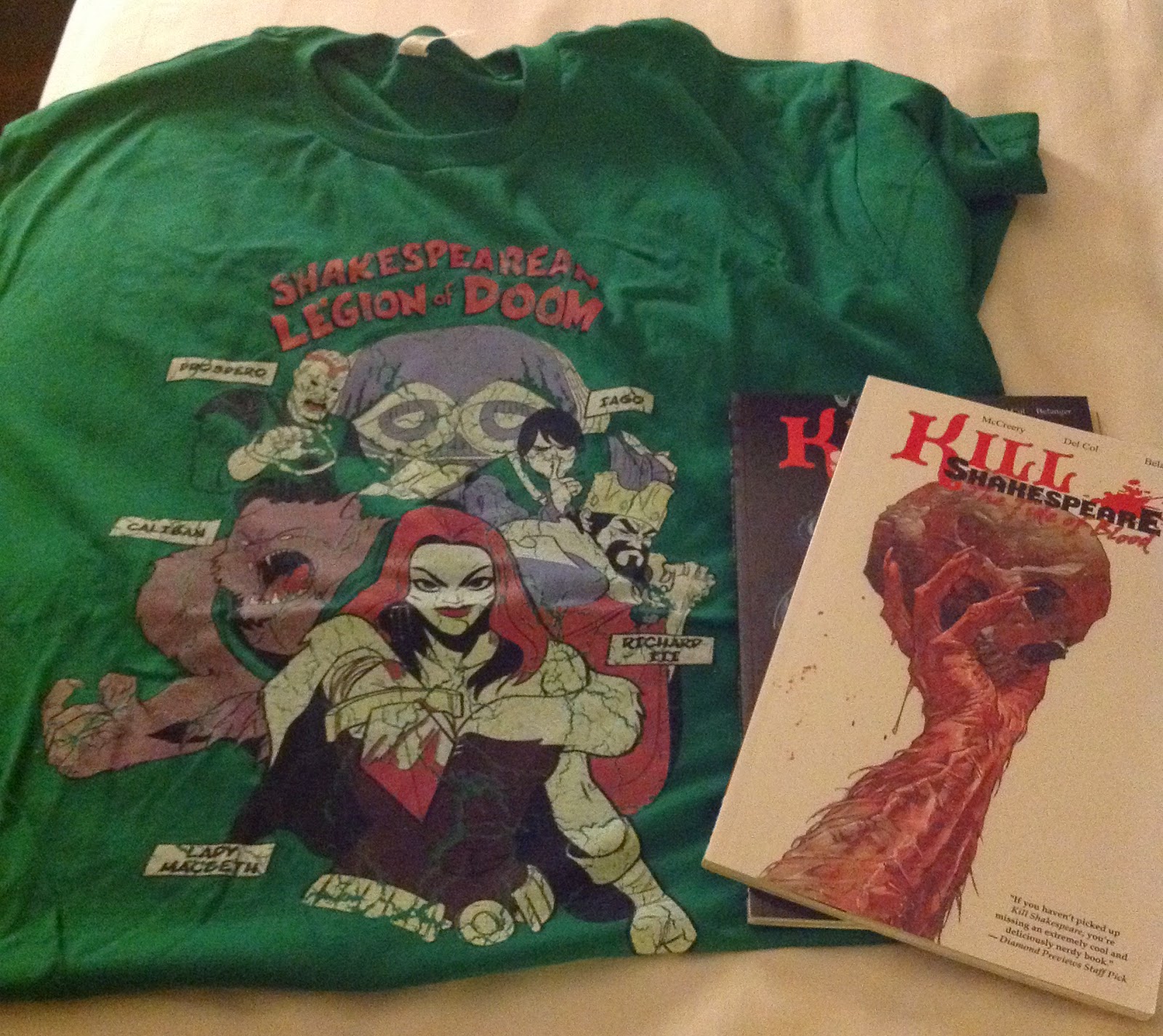
I made two fun purchases this year.  I found the booth for one of my favorite comics, Kill Shakespeare, quite by accident while trying to escape the crush of the Friday afternoon crowd.  They had some incredibly fun t-shirts available, including one of Shakespearean villains.  If you're a fan of this blog you know that I love both Shakespeare and working with villains in my magick.  Next time I need to do a spell that requires the potency and scale of a Shakespearean villain I know what my ritual garb will be ;)

My most exciting (and priciest) find was a licensed replica of Harry Dresden's original shield bracelet.  If you haven't read any of the Dresden Files (oh for shame!), they are an urban fantasy series about a wizard-for-hire living in Chicago who battles baddies of all shapes and sizes.  One of his most important tools is a charm bracelet where each charm is fully imbued with a potent protection spell.  I plan to charge each of the charms on my bracelet to do exactly that.  Not only will it have the power of the intent that I put into it, but also the power of the belief of all the readers of this 15 year (and counting) series - talk about taking advantage of power that's already sitting there ripe for use.

Another incredibly useful PCM tool that you can often only get at conventions is custom artwork.  Many artists will take commissions for custom work at or before conventions.  If one of your favorite artists is available take advantage of that and have them make a piece whose components you can use in your magickal works.  Imagine the prosperity spell you could craft using a piece of custom art as a focus.  As a bonus, art purchased directly from the artist almost always has stronger energy than art that's gone through an intermediary - less energy dilution good!

The options are just about endless in for this sort of thing and it's a great way to both improve the potency of your magick and support your favorite artists.

Energy, energy everywhere! As far as the mind's eye can see!

The energy at a convention is utterly unlike anything else.  The closest thing to it would be a major concert or sporting event, but sustained over several days rather than just a few hours.  There are so many overwhelming emotions pouring everywhere: excitement for all that can be done, joy at seeing your favorite writers/artists/actors, frustration from waiting in lines, etc.  That nearly unlimited energy can be harnessed if you take care.

In most ritual magick you set up sacred space, call on helpful energies and entities, raise energy, and then direct that energy towards your goal.  At a convention you can kind of skip all that and just scoop up the copious energy around you and send it off to wherever it needs to go.

Of course, just because energy is strong and available doesn't necessarily mean it's in tune with your goals.  The energy of a bunch of squeevy dudes drooling over pinups probably won't help you ace your feminist theory class and the energy of a vendor arguing with convention staff won't help your prosperity spell.  Take your time to walk the floor to feel out the energies.  Find the energy that feels most sympathetic to your goals and take a bit from that area.  If you're doing a spell on the fly just be sure to walk through that area when you need to gather energy.  If you're setting up for a larger rite you can always charge a stone, sigil, or talisman while walking through that area.

You can also utilize the energy in panels in pretty much the same way.  Most actors and audiences put off a tremendous amount of energy during convention panels - the more exciting and dynamic the panel, the more energy gets thrown about the room.  You can either come in with a plan to use the type of energy you expect to be generated in the panel, or you can do something on the fly if particularly juicy energy starts flowing.  
I had the pleasure of seeing many panels featuring truly kick-ass women at ECCC.  If I had wanted to so a spell to enhance my self-confidence or assertiveness I would have been absolutely spoiled for choices with so much empowering energy around.  Of course I didn't think about it at the time because I was too busy fangirling.  I'm ok with that.

Sweet Tesla is that...?

Conventions are also filled to the brim with major and minor celebrities.  They're one of the few places where you actually have the chance to interact with your idols - be they artists, writers, actors, etc.  Getting to meet a beloved celebrity (however briefly) is thrilling and at a con you almost always have either an autograph or a photo to take away from that meeting.  That little token can be used (mindfully) as a focus for sympathetic magick. I had the great please of having photo's taken with John Barrowman and Clark Gregg this year.  If I ever need to do a spell for confidence or accepting who I am I've got the perfect focus.


There is on SUPER-HUGE caveat to any magick involving living human beings as symbols - don't mess with the people themselves!  Similes are your friends in this type of magick.  By all means do a spell to "have strength and poise like Haley Atwell when she played Agent Carter."  Do not do a spell to "have Haley Atwell's strength and poise."  Do not suck energy out of your idols; they have enough demands on them already and do not need you making things worse.  Also be careful not to project your expectations onto a celebrity.  Just because they created your favorite character does not mean they act like or have the values of that character.  Celebrities are just people, often charismatic and brilliant people, but still just people.

Part II - Con Survival

For similar info check out:
Pop Culture Magick Index
Magick at Concerts